Top 5 Architecture Trends in 2026
2026 marks a turning point for Singapore architecture.

2026 marks a turning point for Singapore architecture. The industry is shifting from setting the foundations for green initiatives to rigorous execution. The trends reflect a consolidation of prior green initiatives —Green Mark, digital workflows, and inclusive design — while signalling a leap toward next-gen imperatives: net-zero delivery, whole-life carbon visibility, and climate resilience.
Across public and private sectors, architects, developers, and consultants face new demands. Green compliance is now a baseline, and the opportunity lies in how early these considerations are embedded in design.
Award-winning projects from late 2025 show that carbon-conscious architecture gains not only accreditation (e.g., Green Mark Super Low Energy), but cultural and commercial recognition.
Trend #1: Adaptive Reuse and Retrofit
With Singapore targeting 80% of buildings to be green by 2030, adaptive reuse and retrofit is becoming one of the most impactful solutions. Industry bodies, including the Singapore Green Building Council, have strongly encouraged retrofit work for reducing embodied carbon and extending building lifecycles.
In addition, major retrofit works in Singapore are required to meet minimum Building Control (Environmental Sustainability) Regulations. To support this movement, the Centre for Sustainable Buildings and Construction (CSBC), in collaboration with Arup, has published a practical well-structured guide for building retrofits in Singapore’s regulatory best practices.
This shift toward adaptive reuse is also evident in the end 2025 design recognition and awards. Multiple 2025 award juries have celebrated retrofit projects locally and internationally.

Locally at Singapore Institute of Architects (SIA) Awards, projects such as The Reserve ( an old warehouse transformed into a secure vault facility ) were recognised as “a bold architectural statement” that thoughtfully merges heritage and innovation.

Similarly, The Shop Downstairs, an optical retail space, was praised for its sensitive re-purposing of a traditional shophouse through precise modern insertions rather than wholesale alteration.
Internationally, the World Architecture Festival 2025 awarded Woods Bagot the Creative Re-Use category for the Younghusband project in Melbourne, which was skillfully retained while working with existing structures.
Together, these recognitions affirm a growing consensus: adaptive reuse and retrofit now sit at the heart of Singapore’s green building agenda and award-winning architectural practice in a carbon-constrained future.
Trend #2: Carbon Tax and Green Auditing Integration
Singapore’s climate policy has tightened significantly. From 2024 to 2026, the national carbon tax has climbed fivefold (now S$45/ton in 2026), with a projected rise to S$50–80/ton by 2030 (NEA). Taxable facilities may offset up to 5% of emissions using eligible International Carbon Credits under NEA’s framework.
At the same time, climate-related disclosures are becoming more structured. The Monetary Authority of Singapore (MAS) and SGX have introduced phased climate reporting requirements aligned with the ISSB framework, beginning FY2025 for listed issuers. This increases the emphasis on emissions transparency, particularly where projects are linked to green financing. Sustainability-linked loans and green bonds increasingly reference recognised building standards such as Green Mark and LEED as part of their eligibility frameworks.

Regionally, large-scale developments are demonstrating how carbon performance influences financing outcomes. The Ritz-Carlton, Fari Islands (Maldives) project secured a US$180 million green loan conversion, with reported reductions of approximately 6,000 tonnes of carbon during construction.
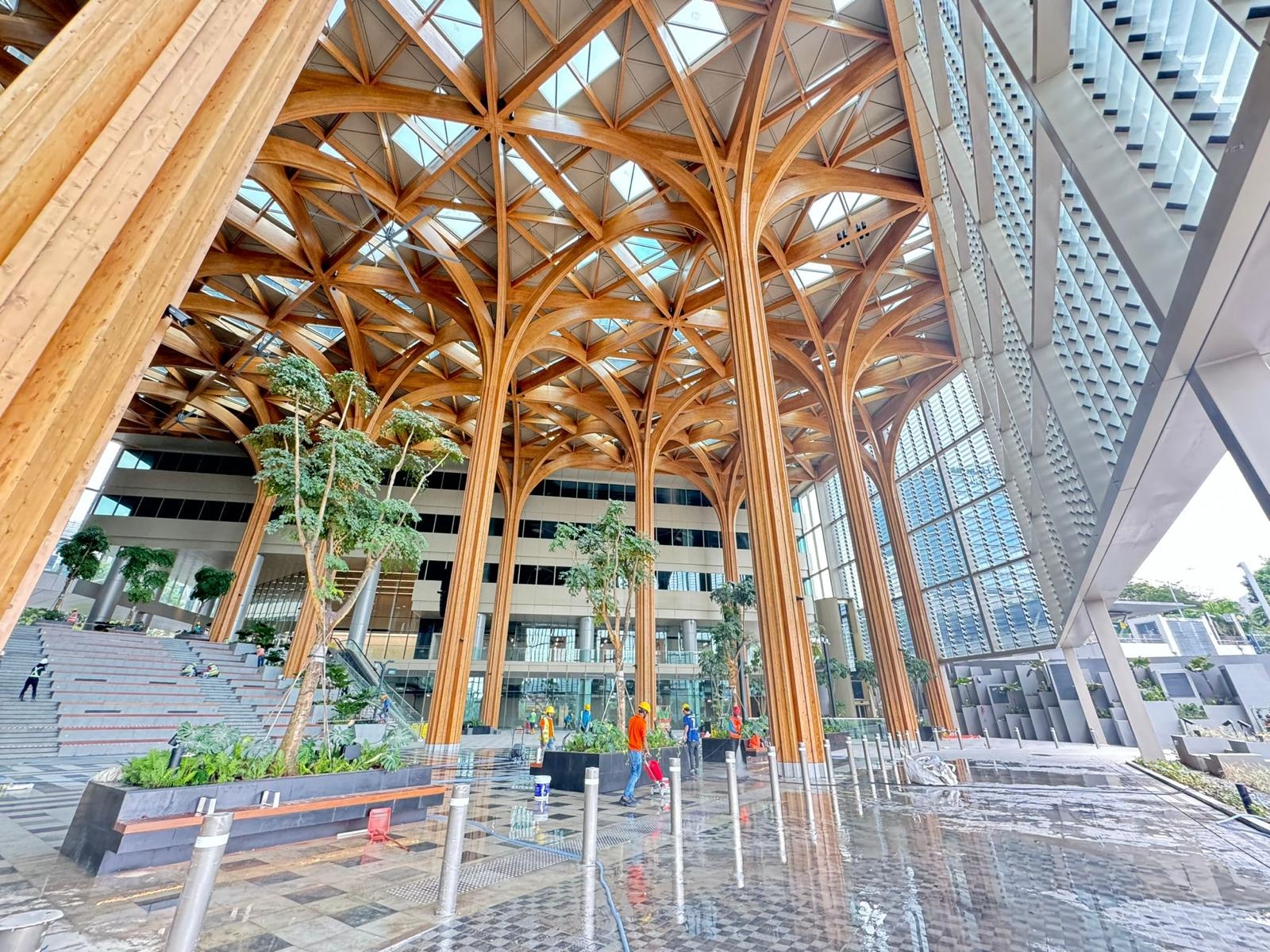
In Singapore, the Geneo canopy — described as the world’s tallest mass engineered timber (MET) canopy — stores an estimated 952 tonnes of net biogenic carbon within its timber structure. While operational performance determines overall lifecycle impact, the project illustrates how structural timber can contribute to embodied carbon reduction strategies.
To support smoother carbon audits and reporting, project teams increasingly reference standards such as ISO 14064 for greenhouse gas quantification and specify materials supported by verified Environmental Product Declarations (EPDs). Calvary Carpentry’s Impact Report contributes to this ecosystem by providing guidance on integrating certified, low-embodied-carbon timber into project specifications, helping teams align material selection with evolving carbon accountability requirements.
Trend #3: Low-Carbon Materials & Whole-Life Carbon:
As Singapore’s green building requirements evolve, there is growing emphasis on reducing both operational and embodied carbon across a building’s lifecycle. In support of Green Mark objectives and carbon reporting frameworks, project teams are increasingly considering lower-carbon material options, including optimised concrete mixes, certified mass-engineered timber, and products incorporating recycled content.
What is Whole-Life Carbon?
A “Whole-life carbon” assessment is the process of tallying the sum of embodied and operational carbon emissions across a building’s full lifecycle, from material extraction to end-of-life.This process is becoming increasingly central to design decisions, spurred by Singapore’s push to decarbonize the built environment.
This shift affects architects, structural engineers, quantity surveyors, and developers alike. Material selection is no longer based solely on cost and performance, but also on embodied carbon data and lifecycle impact. Specifications increasingly reference Environmental Product Declarations (EPDs), recycled content thresholds, and VOC compliance to support transparency and reporting requirements.
Innovative materials such as Accoya and reconstituted bamboo products are gaining interest for their durability (dimensionally stable in tropical climates), performance characteristics (fire-rated), and potential lifecycle carbon benefits (Cradle-to-Cradle, carbon-negative). However, project teams must balance cost considerations with performance requirements and carefully assess the quality and boundaries of carbon data disclosed in supplier EPDs, including upstream (Scope 3) impacts where relevant.
Trend #4: Climate-Adaptive Biophilia
Singapore’s equatorial climate is becoming hotter and wetter, prompting a resurgence in passive and porous design strategies. URA’s Draft Master Plan 2025 prioritises climate resilience and a "City in Nature" urban model, a direction that is echoed by award-winning works.

Multiple award-winning projects illustrate climate-adaptive design. The Kampung House (SIA Awards 2025, Merit) demonstrates tropical passive design, using strategic openness for cross-ventilation so the home needs no air-conditioning.

On a larger scale, Keppel South Central (SIA 2025, Office category) features an “environmental veil” – a second skin facade that shades the tower and cools occupants in warm, wet weather.
Globally, projects like "Embracing Flood" (WAF 2025 winner) showcase how flood-resilient landscapes are becoming design benchmarks.
These examples, recognised by juries, validate climate-responsive strategies—shading, ventilation, and rain protection—as both innovative and necessary in Singapore’s tropical context.
In practice, climate-adaptive design shapes both form and specification. It means using passive strategies like natural ventilation and self-shading massing to improve comfort, while specifying durable, climate-ready materials and performance requirements that withstand heat, humidity, and heavy rainfall over the long term..
#5: BIM Digital Architecture Delivery:

Our in-house architect working on BIM for prefabricated timber detailing.
Building Information Modelling (BIM) is no longer optional, it defines architectural practice heading into 2026. By 1 October 2026, all new architectural submissions, regardless of project size or gross floor area, must be submitted through CORENET X (BCA), making BIM-based digital submission the industry standard.
The BCA Awards 2025 explicitly honoured projects “pushing the boundaries of industry transformation” –
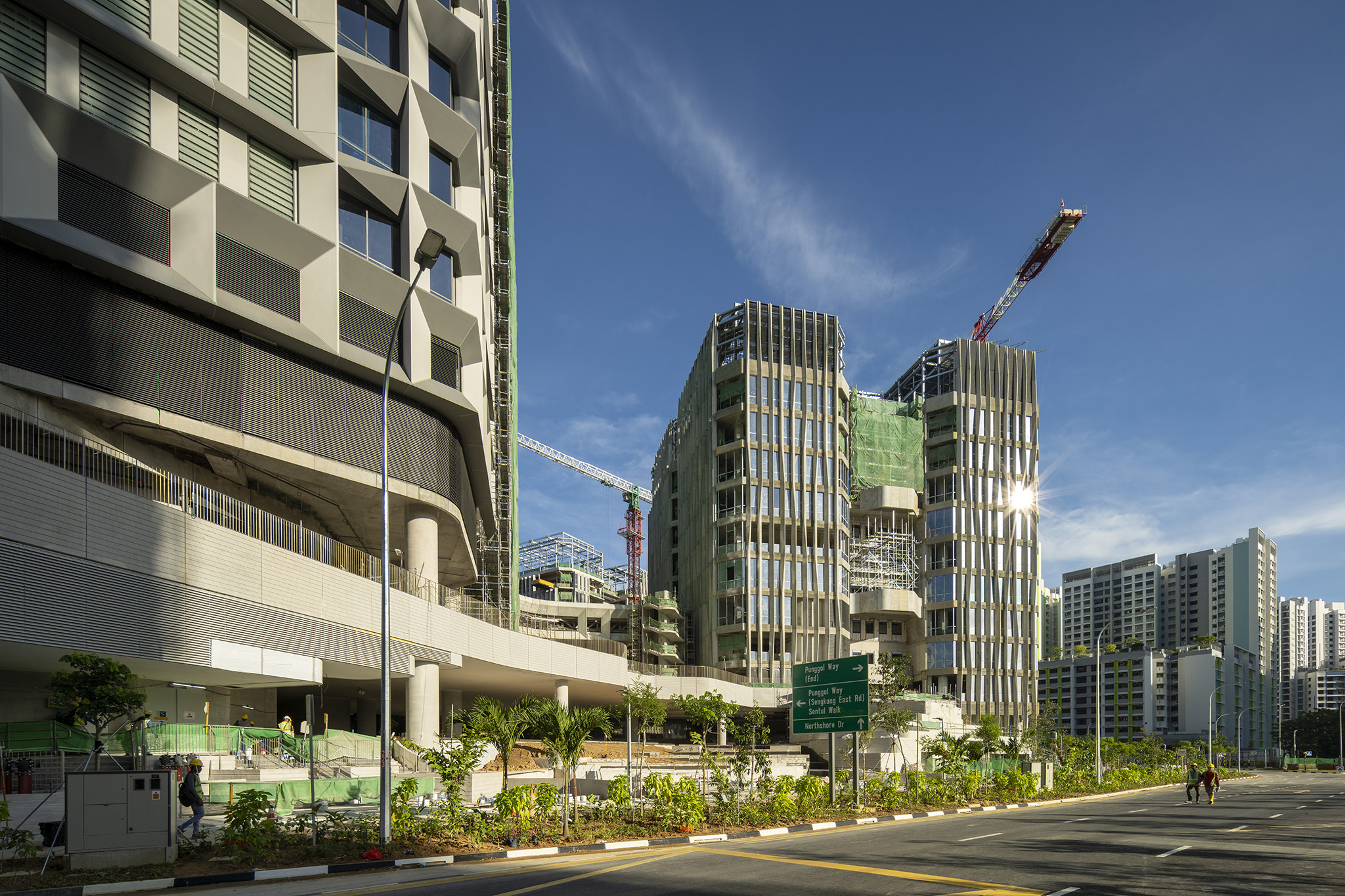
Award programs reflect this shift. Punggol Digital District, winner of the Mixed-Use Buildings category, utilised mass engineered timber (MET) to achieve up to 40% faster construction compared to reinforced concrete. The project also implemented a fully integrated BIM approach, strengthening coordination and delivery efficiency.
 Singapore's First Super Low Energy Resort, Mandai Rainforest Resort
Similarly, Mandai Resort employed off-form precast panels with bio-textures, doubling exterior works speed.
For architects, this means designing to tighter tolerances, coordinating MEP early, and ensuring prefabricated components (e.g. PPVC) comply with transport constraints. Modular design, early clash detection, and shop drawing alignment are now part of the base workflow and not just optional add-ons. For instance, if a project is PPVC, the room dimensions might be set by transport limits (e.g. 3.2m wide modules to fit on roads).
Design increasingly accounts for manufacturability. Projects are structured around modular grids and repetitive units, with layouts influenced by prefabrication and logistics constraints from the outset.
What Does This Mean for Singapore Design?
Together, these five trends define the architecture of 2026: strategic, data-backed, and deeply responsive to tropical climate, carbon policy, and digital transformation.
The policies set the minimum for Singapore’s Roadmap – but the trends and award examples show that pushing beyond yields architecture that is not only future-ready but also a catalyst for Architecture inspiration. Designers must now integrate modern systems into constrained existing structures, navigate legacy fire code issues, and optimise massing for daylight and airflow.
Firms that embed these principles into their workflows early will not only meet regulatory minimums but they'll shape the next era of Singaporean design.
Cheers, The Calvary Carpentry Team

Explore our projects here: https://calvarycarpentry.com/projects
Contact us or come down to our showroom to learn more!